
 EN
EN


Optimizing Cycle Time Through Precision Die Casting Mould Design
Draft Angles, Ejection Systems, and Automated Part Release
Strategic draft angles—typically 1–3°—reduce friction during part separation, enabling smooth, damage-free ejection. When paired with optimized ejector pin placement and fully automated ejection systems, removal time drops by 15–30% per cycle. Uniform wall thickness further supports consistent cooling and dimensional stability, ensuring reliable robotic handling without manual correction.
Gate, Runner, and Sprue Layouts for Minimal Fill Time and Scrap
Feed system design prioritizes laminar metal flow to suppress turbulence-induced defects. Short, tapered runners accelerate molten metal delivery, while computational fluid dynamics (CFD) simulations guide gate positioning to eliminate air entrapment and cold shuts. This integrated approach cuts fill time by up to 40% and reduces scrap from incomplete fills by 22% versus empirically derived layouts.
Conformal Cooling vs. Conventional Channels in Thermal Management
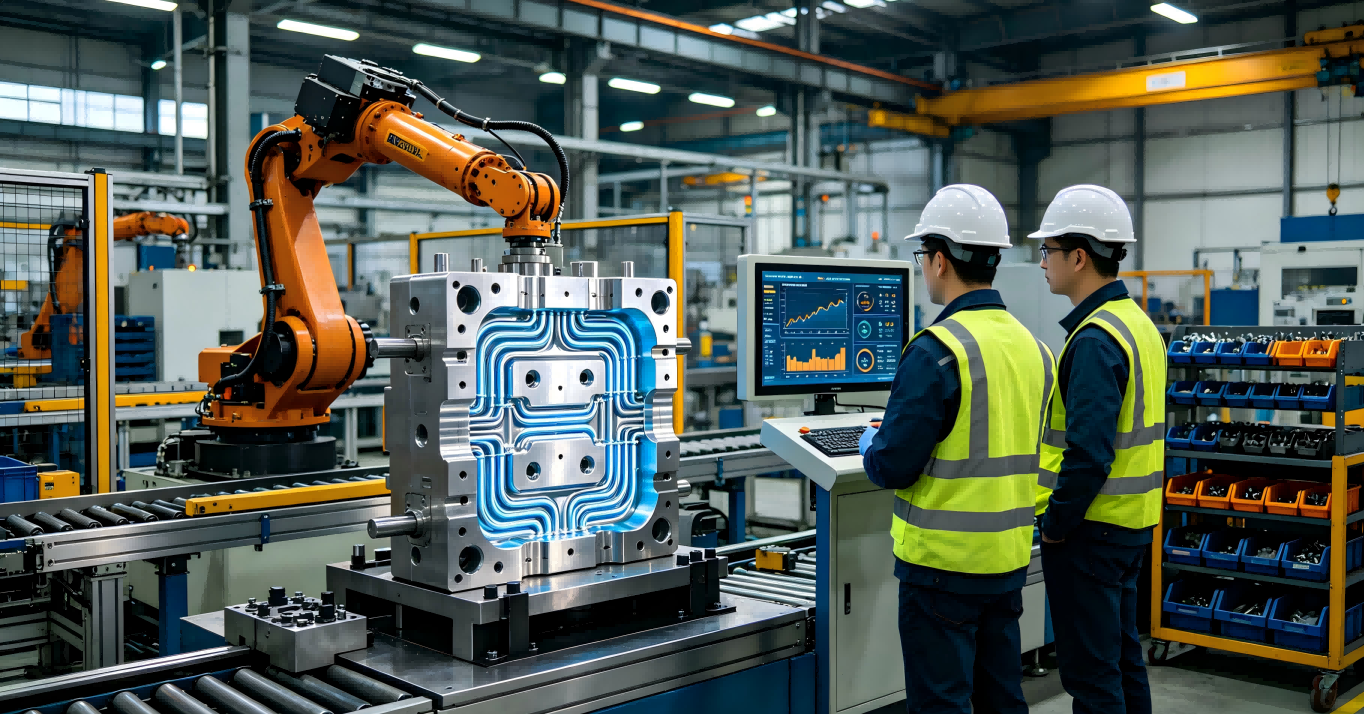
Conformal cooling channels—CNC-machined or additive-manufactured to follow part contours—extract heat 30% faster than straight-drilled channels. By sustaining ±5°C thermal uniformity across critical surfaces, they shorten cycle times by 15–25% and significantly delay thermal fatigue cracking—extending mould service life by approximately 50,000 cycles over conventional cooling.
Minimizing Defects with Robust Die Casting Mould Structure
Uniform Wall Thickness and Balanced Cooling for Stable Cycles
Consistent wall thickness prevents localized hot spots and uneven solidification, reducing residual stress and thermal gradients by up to 60% compared to variable-thickness designs (International Journal of Metalcasting, 2023). Paired with balanced cooling channel distribution—maintaining temperature differentials under 15°C across functional zones—this ensures predictable shrinkage, eliminates cycle-delaying hot spots, and lowers ejection force requirements. The result is stable, high-precision production holding ±0.1mm dimensional tolerance across consecutive cycles without operator adjustment.
Mould-Induced Defects: Porosity, Shrinkage, Cracks, and Warpage
Over 70% of casting defects trace directly to suboptimal mould geometry—not process settings. Inadequate venting causes subsurface porosity; non-conformal cooling promotes shrinkage cavities in thick sections; asymmetric heat extraction drives warpage; and sharp transitions concentrate stress up to 8× nominal levels, initiating cracks. Proven countermeasures include angled ejector pins to limit part distortion, progressive gating to suppress turbulent filling, and CFD-guided vacuum vent placement—each targeting root-cause physics rather than downstream symptom management.
Leveraging Simulation and DFM to Future-Proof Die Casting Mould Performance
Filling, Solidification, and Stress Simulation in Early-Stage Design
Virtual prototyping—deployed before tool fabrication—identifies risks like porosity, sink marks, and warpage with high fidelity. CFD models optimize gate location and runner geometry; thermal stress analysis forecasts distortion patterns affecting dimensional stability; and finite element analysis (FEA) validates structural resilience under clamping and thermal cycling loads. Industry data shows manufacturers adopting this workflow cut development time by 50% and lift first-pass yield rates by 30% (FDB Casting, 2023), avoiding costly physical iterations.
Cavity Count, Projection Area, and Force Analysis for Scalable Mould Layouts
Design for Manufacturability (DFM) anchors scalability in physics-based decisions. Engineers calculate required clamping force from projected area, material viscosity, and wall thickness consistency—ensuring flash-free operation at target shot volumes. Runner systems are engineered for balanced filling and minimal scrap; ejection mechanisms are simulated under high-cycle conditions to prevent part deformation. Stress distribution modeling reveals how multi-cavity configurations affect load paths and thermal fatigue, guiding layouts built for 100,000+ cycles. This analytical foundation reduces per-unit costs by 18% when scaling production (Industry Benchmark, 2023).
Frequently Asked Questions
What are draft angles in die casting mould design?
Draft angles in die casting mould design are typically 1–3° angles that help reduce friction during part separation, enabling smooth and damage-free ejection of the parts.
How does conformal cooling improve thermal management in die casting?
Conformal cooling channels, which are either CNC-machined or additively manufactured to match part contours, extract heat 30% faster than conventional channels, shortening cycle times and extending mould service life.
Why is uniform wall thickness important in mould design?
Uniform wall thickness prevents localized hot spots and uneven solidification, reducing residual stress and thermal gradients, which leads to stable and high-precision production.
How does simulation aid die casting mould performance?
Simulation, including virtual prototyping and various analyses like CFD and FEA, helps identify risks and optimize design prior to tool fabrication, reducing development time and increasing first-pass yield rates.