
 EN
EN


Mold Design Expertise: The Foundation of Efficient Die Casting
How geometric complexity demands multi-disciplinary mold maker expertise
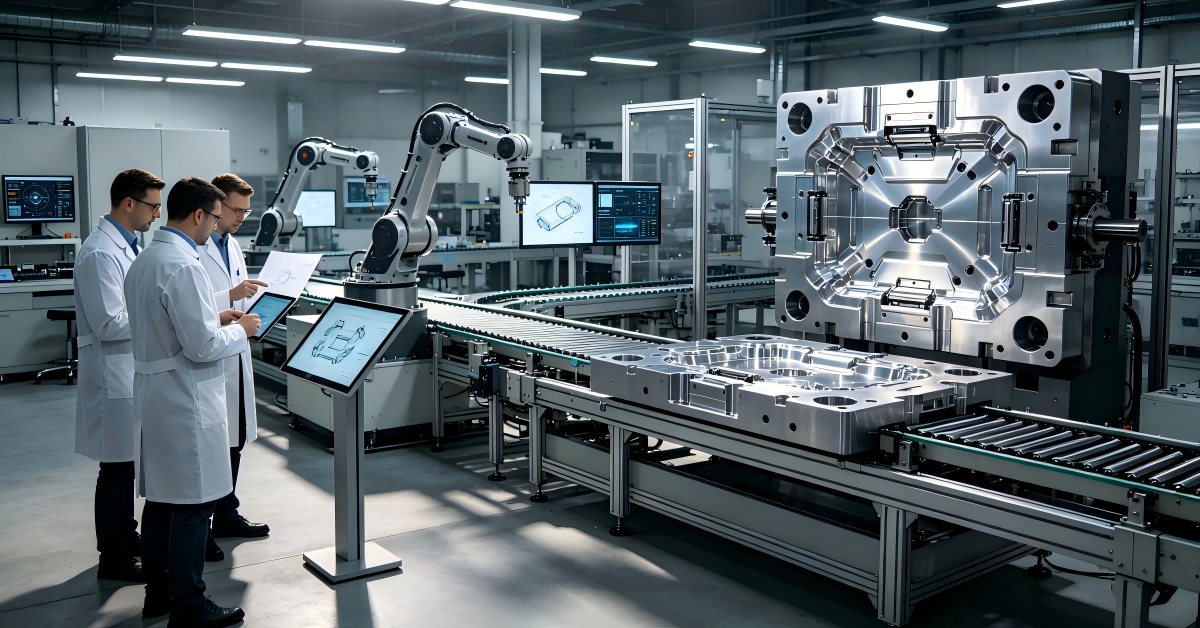
Modern die-cast components increasingly feature thin walls, intricate contours, and internal features—challenges that demand integrated expertise across fluid dynamics, thermal engineering, and structural mechanics. A skilled mold maker translates complex CAD models into functional tooling not in isolation, but through close collaboration with metallurgists (to predict alloy behavior), simulation engineers (to model metal flow and solidification), and tooling designers (to ensure manufacturability). Without this cross-functional approach, geometric complexities—such as uneven wall thickness or sharp transitions—introduce turbulence, air entrapment, and incomplete filling, undermining part integrity from the outset.
Anticipating flow, shrinkage, and ejection challenges—why experience reduces trial-and-error
Seasoned mold makers leverage decades of failure data to preempt defects before steel is cut. Flow imbalances from asymmetrical gates cause cold shuts; differential shrinkage at thick-thin junctions induces internal stresses; insufficient draft angles result in ejection damage or distortion. By simulating these failure modes early, expert teams reduce costly mold reworks by 40–60% compared to iterative trial-and-error methods. This proactive mitigation of thermal contraction and ejection forces ensures consistent part quality while extending mold service life—turning empirical insight into repeatable process control.
Precision Thermal Management: Cooling Channels and Defect Prevention
Conformal cooling design: How professional mold makers achieve uniform solidification
Professional mold makers deploy conformal cooling channels—precisely contoured to follow the mold’s geometry—to enable uniform heat extraction across complex part shapes. Unlike conventional straight-line channels, conformal layouts eliminate localized hotspots, ensuring even solidification and minimizing warping, sink marks, and residual stress. Optimized via advanced thermal simulation, these systems improve dimensional accuracy, shorten cycle times, and support high-precision applications where micron-level stability is non-negotiable.
Data insight: 37% porosity reduction with expert-designed conformal cooling (NADCA, 2023)
According to the North American Die Casting Association’s 2023 benchmark study, expert-designed conformal cooling systems reduce porosity by 37% compared to conventional cooling. Porosity—often caused by trapped gases during uneven solidification—directly compromises mechanical strength and surface finish. This improvement stems from consistent heat dissipation, which promotes directional solidification and tighter microstructure control. The result is fewer rejected parts, lower scrap costs, and extended mold longevity—making conformal cooling a cornerstone of defect-free, high-volume production.
Simulation-Driven Validation: From CAD to First-Piece Success
How professional mold makers integrate thermal, structural, and flow simulation pre-manufacturing
Advanced simulation tools have redefined mold development—shifting validation from physical trial-and-error to virtual certainty. By integrating thermal, structural, and flow analyses directly within the CAD environment, mold makers predict and resolve defects before machining begins. Thermal simulations optimize cooling channel placement to prevent warping; structural analysis verifies mold integrity under clamping pressures up to 2,500 tons; flow modeling identifies filling imbalances, air traps, and premature freezing. Industry benchmarks confirm this approach reduces first-piece correction cycles by up to 75%. When cooling rates, ejection forces, and material flow pathways are aligned digitally, molds consistently meet target tolerances on initial production runs—accelerating time-to-market and ensuring dimensional stability across millions of cycles.
Durability, Precision, and Long-Term Production Stability
H13 Steel vs. Aluminum Tooling: Balancing Thermal Fatigue Resistance, Part Fidelity, and Mold Maker Capability
Material selection is foundational to long-term production stability. H13 tool steel delivers superior thermal fatigue resistance—critical for high-volume, high-temperature die casting—minimizing stress cracking and preserving dimensional accuracy over 100,000+ cycles. Aluminum tooling enables faster heat transfer and shorter cycles but sacrifices durability under sustained thermal loads, increasing risk of warping and part deviation after ~10,000 shots. A skilled mold maker evaluates these trade-offs holistically—using simulation to guide material selection, reinforce critical zones, and maintain micron-level fidelity across extended runs. In practice, H13 typically achieves 10× longer service life than aluminum in high-heat applications, while optimized aluminum tooling remains viable for low-volume, rapid-turnaround programs—ensuring uptime, repeatability, and predictable cost performance.
Total Cost of Ownership: Why Professional Mold Making Delivers Strong ROI
Professional mold making delivers compelling ROI by optimizing Total Cost of Ownership (TCO)—a holistic metric encompassing tooling investment, maintenance, scrap, energy, and production stability. Though upfront costs may be higher, partnering with an expert mold maker reduces cost per part by up to 22% over high-volume runs (e.g., 500,000 cycles) through:
- Precision engineering, eliminating dimensional errors that trigger downstream rework
- Durable materials, such as H13 steel, engineered to resist wear across sustained production
- Efficient cooling designs, cutting cycle times and energy consumption
- Proactive maintenance planning, avoiding unplanned downtime—costing industry averages of $740,000/hour (Ponemon Institute, 2023)
This ROI manifests in scrap rates below 0.5% (versus 3–8% with low-cost tooling), mold lifespans exceeding 1 million shots, and zero post-casting corrections. For high-volume operations, every 1% reduction in cycle time yields $18,000–$50,000 in annual savings per machine—affirming that expert mold design isn’t an expense, but a strategic lever for profitability and operational resilience.
FAQs
Why is mold maker collaboration crucial for complex die-cast components?
Collaboration ensures that geometric complexities in die-cast components are optimized for manufacturability, reducing turbulence, air entrapment, and defects.
What benefits do conformal cooling channels provide?
Conformal cooling channels eliminate localized hotspots, ensure uniform solidification, improve dimensional accuracy, and reduce production cycle times.
Why is H13 tool steel preferred for high-temperature applications?
H13 tool steel offers superior thermal fatigue resistance, ensuring longer mold life and stable part dimensions over extended production cycles.
How does simulation-driven validation reduce defects?
Simulations predict thermal, structural, and flow anomalies before manufacturing starts, reducing correction cycles and ensuring first-round operational success.
How does professional mold making impact ROI?
It reduces costs per part through precision designs, durable materials, and efficient cooling systems, while minimizing scrap rates and downtime costs.
Table of Contents
- Mold Design Expertise: The Foundation of Efficient Die Casting
- Precision Thermal Management: Cooling Channels and Defect Prevention
- Simulation-Driven Validation: From CAD to First-Piece Success
- Durability, Precision, and Long-Term Production Stability
- Total Cost of Ownership: Why Professional Mold Making Delivers Strong ROI
- FAQs